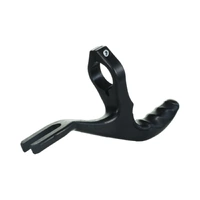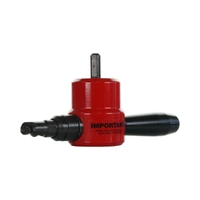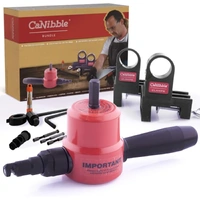

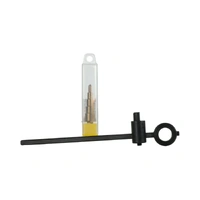
Circle Attach
NEW
CaNibble ATT01 | Straight & Circle Cutting Attachment For Nibbler
$29.95
$27.23 ex. GST
Search Results:
Search Results:

Discover CaNibble, the Australian-made metal nibbler that attaches to your drill. Cut metal up to 2mm thick with precision, without sparks, distortion or burrs. [ Read More ]
Cutting thin sheet metal with a grinder or snips brings three problems. Sparks fly, the edge comes up sharp, and the sheet buckles. CaNibble was built to deal with all three at once.
The head punches a narrow strip out of the metal. Nothing spins against the sheet, so there is no friction heat and no spark shower. That is the main difference between a nibbler and a cutting disc.
A nibbler follows a drawn line well, but it will follow a crooked one just as happily. A deep-hole marker such as Pica-Marker sets a line that stays visible on oily or galvanised sheet.
CaNibble is built for sheet work rather than solid bar or thick plate. The table below shows the materials it is designed to handle and where each one tends to turn up on a job.
| Material | Where It Comes Up | Notes |
|---|---|---|
| Mild steel | General fabrication, brackets, trays | The everyday case for a nibbler |
| Stainless steel | Kitchens, splashbacks, food sites | Tougher, so watch the thickness limit |
| Aluminium | Panels, profiles, light framing | Cuts easily and will not load up the die |
| Brass | Trim, plates, fittings | Soft, so edges stay very clean |
| Corrugated iron | Roofing and shed work | Rides over the profile rather than flattening it |
| Plastic sheet | Guards, covers, enclosures | No melted edge, unlike a hot blade |
| Fibreglass | Panels and cladding | Punching keeps the dust down |
CaNibble is not limited to straight cuts. The small head turns inside its own width, so it can take a curve, a circle or a cut-out with a corner in it. For long straight runs and set circles, a guide attachment holds the line for you.
For round holes in flat sheet, a hole saw or a step drill is still the quicker option. The nibbler earns its keep once the shape stops being round.
Thickness limit: 2mm is the upper figure for compatible sheet metals. The real limit depends on the metal and its temper, so check the product specifications before cutting, and wear eye protection. Punched strip comes away sharp.
A grinder is faster down a long straight line in heavy plate. On thin sheet, detailed shapes or anywhere sparks are a problem, the comparison swings the other way.
| Factor | CaNibble Nibbler | Angle Grinder |
|---|---|---|
| Cutting method | Mechanical punch | Abrasive disc |
| Sparks | None | Heavy spark stream |
| Heat into the sheet | Very little | High, can warp thin panels |
| Edge finish | Clean, few burrs | Often needs dressing back |
| Curves and cut-outs | Handles them well | Hard to steer |
| Power source | Any suitable power drill | Its own motor |
| Thick plate | Not suited | Better choice |
Hand tools still have a place on the same job. Hacksaw blades suit short cuts in bar and tube, and cutting pliers handle wire and small trims.
The CaNibble range at Sparky Direct covers the nibbler itself, the wear parts that keep it cutting, and the guides that make the cut accurate.
The core tool. A compact drill-powered head for cutting sheet metal to a line.
The nibbler packaged with compatible accessories, for anyone starting from nothing.
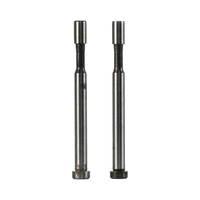
The punch and die do the cutting and wear out first. Keeping a spare set on the van avoids a stopped job.
A guide for long straight runs and set-diameter circles, where a freehand line will not hold.
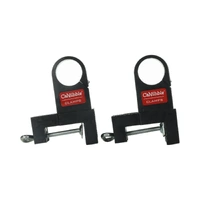
Clamping gear so the sheet stays put while the nibbler works along the line.
Sheet metal work rarely needs one tool. The wider electrical tools range covers hand tools, drywall saws, conduit cutters and tool bags to carry the lot.
Trade tool brands stocked alongside CaNibble include Klein Tools, Wiha, Felo, Alpha and CABAC.
The story starts in the aviation trade more than four decades ago. In the early 1980s a major aviation firm asked an inventor for a better way to cut aircraft skin, which is made from aluminium and aluminium alloys.
The brief was simple and hard at the same time: a portable tool that cuts metal to a line without sparks, burrs or sharp edges.
The answer was the Turner Nibbler, a drill-powered cutter patented in 1985. Next to the bulky machines of the day, it was small enough to carry to the work. The design was later patented and sold through Europe and the United States, and it set the shape of the drill-attachment nibbler used today.
The Turner Nibbler was only the start. Over the years that followed, its creator kept working on the weak points of nibblers in general.
One key change was an up-stroke cutting action, which made the punch stronger and cut down on breakages. Later work on the die reduced wear, made punches last longer and made the head easier to steer.
Those changes became the Professional Nibbler, built in Perth after the business moved to Australia in the early 2000s. It went on to sell in Australia, New Zealand and Japan.
CaNibble is where that line of work ends up. The driveshaft was reworked to grip better in the drill chuck and pass on more of the drill's power. The punch was changed again, in both material and the way it is made, so it lasts longer under load.
What started as a question from the aviation trade is now an Australian-made tool used for sheet metal work around the world.
Quality products in stock • Fast Australia-wide delivery • Competitive trade pricing
Browse CaNibble → Get Expert Advice →CaNibble is an Australian-made metal nibbler that runs off a power drill. It cuts sheet metal using a mechanical punching action rather than an abrasive cutting disc.
CaNibble is advertised as cutting compatible sheet metals up to 2mm thick. The real limit depends on the metal and its temper, so check the product specifications before cutting.
No. CaNibble punches the metal instead of grinding it, so it cuts suitable sheet metals without the spark stream that comes off an angle grinder or cutting disc.
CaNibble is designed to leave a clean edge with very few burrs. The finish depends on the material, the cutting technique and the condition of the punch and die. Handle cut metal carefully either way, as the punched strip comes away sharp.
Yes. The small cutting head turns inside its own width, which suits curves and detailed cut-outs. A straight and circle cutting attachment is also available for set shapes.
CaNibble fits a standard power drill chuck. Check the manufacturer's requirements for drill compatibility and operating speed.
CaNibble is Australian made. The design traces back to nibbler technology developed for the aviation trade, and its predecessor, the Professional Nibbler, went into production in Perth in the early 2000s.
An angle grinder cuts with a spinning abrasive disc, which throws sparks, puts heat into the sheet and leaves burrs. CaNibble punches the metal instead, so it suits thin sheet, detailed shapes and any job where sparks or warping are a problem. A grinder is still the better tool for thick plate.
CaNibble is designed to cut mild steel, stainless steel, aluminium, brass, corrugated iron, plastic sheet and fibreglass, up to 2mm thick depending on the material. It suits sheet work rather than solid bar or thick plate.
Sparky Direct stocks the CaNibble range and ships Australia-wide, with fast dispatch to any address in the country. More than 400,000 customers have been served since 2005, with a Google review rating of 4.9 out of 5 from more than 8,000 reviews. Save time, shop online at Sparky Direct.